Executive Summary
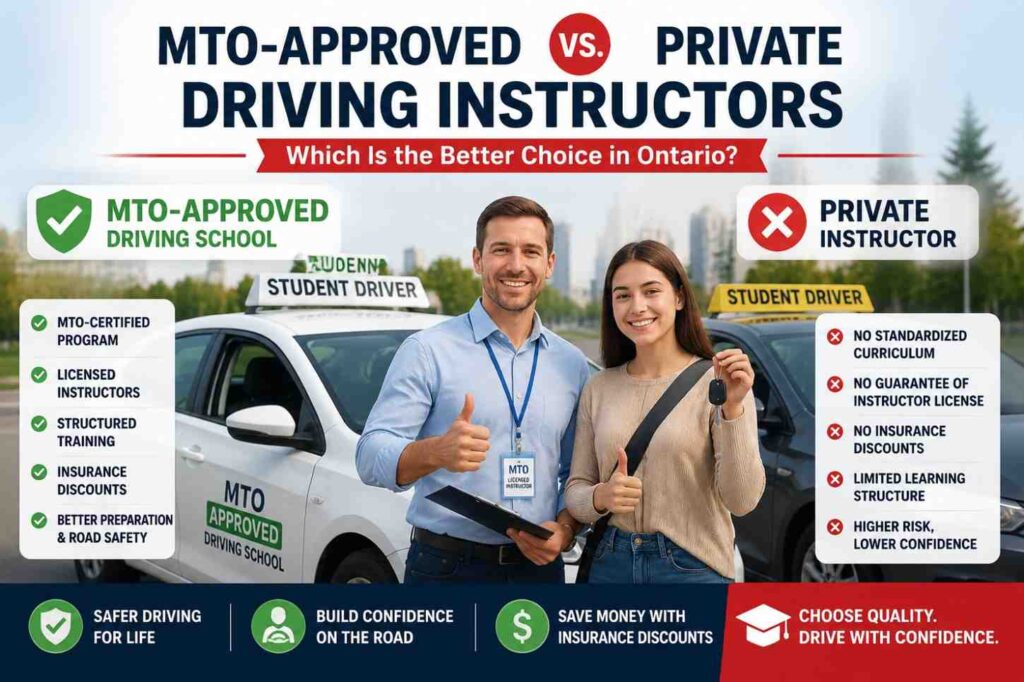
As an Ontario driving instructor, I know that choosing an MTO-approved program means not just meeting licensing rules, but also reaping long-term benefits like insurance savings and top-quality training. MTO-certified beginner driver education (BDE) courses are standardized by the Ministry, include 40 hours of instruction (20 theory + 10 in-car + 10 online), and qualify new drivers for G2 eligibility 4 months early. Graduates typically earn 10–15% insurance discounts (sometimes up to 20–30%) with major insurers, offsetting the course cost over time. In contrast, independent private lessons may save money upfront but lack guaranteed curriculum standards, dual-control vehicle use, or G2-accelerating benefits.
MTO-Certified Training Requirements
Ontario law requires that any paid Class G driving instructor hold a valid MTO driving instructor’s license, which is only issued after meeting strict criteria. To qualify, an instructor must be at least 18, have a clean driving record, pass a criminal record check, pass a Class G road test, and complete an MTO-approved instructor course. In practice this means MTO-certified instructors are trained to high standards and must display their instructor license in the car at all times. By contrast, an unlicensed “friend or family” tutor has no such oversight.
Similarly, MTO-approved driving schools follow a standardized curriculum. Ontario Regulation 473/07 mandates that a government-approved BDE program includes at minimum 40 hours of training: 20 hours classroom theory (or virtual), 10 hours in-vehicle practice, and 10 hours of flexible instruction (e-learning or homework). This ensures every student learns the full range of road rules, hazard perception, and driving skills. In contrast, private lessons often skip the theory classes altogether, focusing only on driving practice. For example, one Ottawa driving school explains that a complete BDE course “meets the full 40-hour MTO-approved program requirement,” including theory and driving. A private instructor might offer 10–20 hours of lessons, but without the same classroom component or formal certificate.
Training Quality & Safety Standards
The structured BDE curriculum is designed to build safe driving habits systematically. Lessons cover defensive driving, intersection observation, highway maneuvers, and parking under supervision. According to Ontario’s DriveTest authority, candidates trained in structured programs consistently perform better on road tests. Road tests focus on key skills – checking mirrors, speed control, hazard anticipation – and approved programs explicitly train those skills. By contrast, private lessons may only cover immediate needs (e.g. a quick highway practice), without ensuring the same breadth of competencies.
Safety is further ensured by the use of dual-control vehicles. All MTO-approved schools must use well-maintained cars equipped with extra pedals and mirrors so the instructor can intervene if needed. In practice, this means a student can practice tricky maneuvers (like emergency braking or lane changes) with the instructor’s foot on the spare brake. I always remind students that this shared control feature is a huge safety advantage of professional lessons. Private instructors are supposed to follow the same rules, but there is less oversight, so you have to double-check their vehicle. A branded training manual even highlights these “unique controls, such as an extra brake on the passenger side” in approved school cars.
Dual-Controls & Insurance
Importantly, approved training vehicles also carry the required 6D insurance endorsement (proof of extra liability coverage for training). When verifying a school, ask if their car has dual controls and the 6D policy. A professional school will have all this clearly documented. In fact, one driving school blog explicitly tells students: “ask directly: ‘Do you have instructor insurance and dual brake controls in your car?’ – a professional instructor should answer confidently
G1/G2 Waiting Period Reduction
One of the biggest concrete advantages of an MTO-approved BDE program is the graduated licensing benefit. Normally, after passing the G1 written test, drivers must wait 12 months before taking the G2 road test. Completing a certified BDE course shaves four months off this period – a G2 test can be taken after only 8 months. I always point out to learners that’s 4 months of extra driving experience under your belt on a G2 (and earlier access to full G). That accelerated timeline not only saves time but also saves money: reaching the full G license a few months earlier means you can drop off the high insurance rates that new drivers pay (G drivers pay less than G2 holders over time).
No private lesson offers this advantage, because only the MTO-approved course counts. As one driving school notes, “Private lessons alone… do not qualify for the 8-month reduction. Only a formal MTO-approved BDE certificate will”. In other words, if you skip the BDE course, you’ll have to wait the full year for G2, with no exception.
Insurance Discounts for BDE Graduates
Perhaps the most tangible financial benefit of a BDE course is lower insurance premiums. In Ontario, major insurers expect new drivers to take formal training, and most offer a discount for BDE completion. Industry experts note that the typical discount range is 10–15% of the premium. For example, SafePass Driving School (an MTO-certified instructor) reports that “the BDE discount ranges from 10 to 15 percent with most major Ontario insurers”. A market analysis concurs: completing a certified course can save roughly 10–20% in Ontario.
In practical terms, on a $3,000/year policy that’s $300–$600 saved annually. A Kruzee driving instructor’s blog even calculates that a 20% discount yields $1,200 a year in savings, easily paying for the ~$600–$800 BDE course in 1–2 years. Popular insurers like Intact, Aviva, TD, BelairDirect, Economical, and Wawanesa all explicitly recognize the MTO BDE certificate, though you must notify them and provide the certificate number to claim it.
It’s worth noting that while the amount varies by insurer and your specifics, the discount is repeatable each year as long as your record is clean. One Ontario driving expert explains: once an insurer has your BDE certification on file, the premium reduction continues at every renewal. (Even after G2/G, the certificate stays useful – it simply applies on top of future rate decreases.)
In contrast, there are no similar savings for private lessons because brokers only look for formal BDE certification. Many students don’t realize that insurance companies treat “lesson certificates” differently. As one Ontario driver’s blog puts it: “Only lessons completed as part of a formal MTO-approved BDE program count toward the official certification. Standalone private lessons are excellent for skill development but do not qualify a student for graduated licensing benefits on their own.”. In short, you won’t see the lower rate unless you complete an approved course.
Private Lessons: Flexibility vs. Structure
So why do some people still choose private instructors? Private lessons can be cheaper per hour (no classroom overhead) and highly flexible. They’re often chosen by older learners or those supplementing training before a test. For example, a student with a G2 license who just needs highway practice might find individual lessons convenient.
However, private lessons lack several benefits of an MTO program:
- No Certificate: You won’t get a BDE certificate for insurance or licensing credits.
- Curriculum Gaps: Private instructors set their own agenda. They might skip topics like collision prevention or highway merging if the student is already past basics. There is no standardized exam at the end.
- No Guaranteed Safety Standards: Although good private instructors should also have dual-control cars and insurance, it’s not enforced by any ministry regulation (unlike in approved schools). You should always ask to see proof of instructor’s license, vehicle insurance, and dual controls.
- Potential Lower Accountability: MTO-approved schools must track lessons and report completions electronically. There’s a formal record. Private instructors may not have the same obligations, so it can be easier to slip in subpar training.
That said, private lessons do have their place for certain situations (see below). But for a new driver starting out, I always emphasize that the “full package” of the MTO program ultimately leads to better preparation. A driver trained under a complete course will have practiced every essential maneuver in a predictable sequence.
Long-Term Cost-Benefit
Many learners worry about the upfront cost difference. A typical MTO BDE program might cost $600–$900 for the entire 40-hour course, whereas 10 private lessons might cost only $400–$500. On paper, the private option looks cheaper. But the long-term view flips the picture.
Consider this: a $700 BDE course yields an annual savings of $300–$600 in insurance, plus getting a G2 four months earlier. Over 3–5 years of driving, that’s thousands saved. An analysis by a driving school found that even a modest 10% discount on insurance could recover the course fee in just 2–3 years. Moreover, finishing in 8 months instead of 12 means you hit the lower G-rate premium sooner.
Safety outcomes also have value. Studies and road test data show that students from certified courses tend to have higher first-time pass rates and lower crash statistics than those without formal training. While I don’t have an exact crash statistic to cite, it’s intuitive: more hours of guided training usually create safer habits. Insurance companies agree by rewarding that training with lower risk ratings (often described as “earning 3 extra stars” on your policy after a BDE).
Practical Questions to Ask Before You Book
Before you book your first lesson, here are some key questions every learner (and parent) should ask any instructor or school:
- “Are you licensed by the MTO? Is your school government-approved?” Verify the instructor’s license number and that the school offers an official BDE certificate. (Without this, you can’t claim G2 time reduction or insurance savings.)
- “Will I use a dual-control vehicle with full instructor insurance?” Ensure the car has an extra brake and is insured with the proper Endorsement (6D) for driving instruction. Safety first!
- “How many hours and in what format?” Confirm that the program includes 40 hours (20 theory + 10 driving + 10 online/self-study) as required by Ontario law. Ask to see the curriculum. If it’s just “lesson by lesson”, you might miss out on important topics.
By asking these, you’ll know if you’re getting a complete, MTO-backed education or something more informal.
In summary, MTO-approved training offers unmatched long-term value. It delivers structured learning from licensed professionals, safer cars, accelerated licensing, and insurance rewards. Private lessons can complement a BDE program (or serve experienced drivers), but on its own a private-only route means missing out on those key benefits. Choose the option that aligns with your goals: for a new driver seeking the safest and most economical path, the MTO-certified school is typically the smarter investment.
Practical Questions for Learners:
- Are you an MTO-certified instructor and is your course approved by the ministry?
- Is the training vehicle fully insured with dual controls (extra brake) for student safety?
- Does your program include the full 40 hours of BDE (classroom, in-car, and online) and provide the official certificate?
Leave a Reply