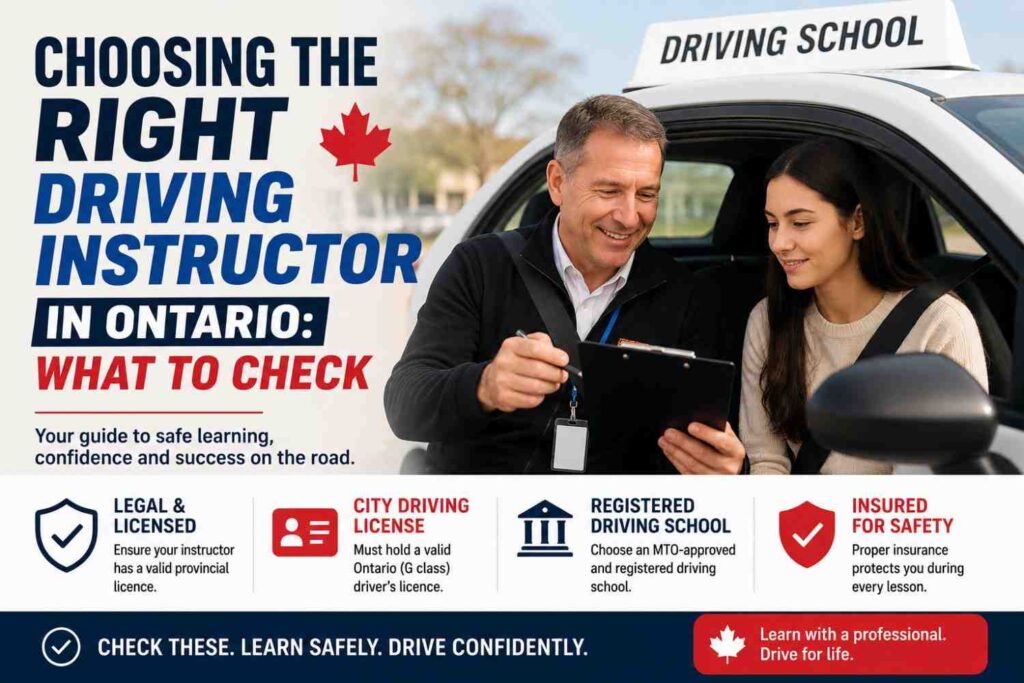
Choosing a MTO approved driving instructor is one of the most important decisions a new driver can make. The right driving instructor does more than teach you how to turn the wheel or park a car. They help you build confidence, understand the rules of the road, and develop safe habits that stay with you for life. In Ontario, there are a few specific things you should check before booking lessons, especially if you want to make sure you are learning from someone who is properly licensed, registered, and insured.
1. Check that the Instructor is Legally Licensed in Ontario
This is the first thing I tell students and parents to verify. In Ontario, a person must hold a valid MTO approved driving instructor licence to provide in-vehicle driving instruction. The province’s licensing rules also set out requirements such as being at least 18 years old, holding a valid Ontario driver’s licence, passing the required checks and tests, and completing an approved instructor’s course.
A licensed instructor is not just “someone who knows how to drive.” They are authorized to provide instruction under Ontario’s Highway Traffic act, which is important for both quality and safety.
When you speak to an instructor, ask directly: “Are you licensed in Ontario?” Do you have Instructor Insurance and Dual Break in your car? A professional instructor should be able to answer clearly and confidently.
2. Make sure the Driving School is Ministry-Approved
If you are booking lessons through a school, check that the school itself is approved by the Ministry of Transportation. Ontario says ministry-approved driving schools are listed on the ministry’s website, and DriveTest notes that school-approved BDE courses are delivered by MTO-licensed schools.
This matters because approved BDE courses come with real benefits. DriveTest says an MTO-approved BDE course can reduce the time spent at the G1 level, and may also provide potential insurance rate discounts.
A school that is properly approved should not be hiding this information. You should be able to see the licence or approval details, and Ontario’s rules say a licensed driving school must display a copy of the driving school licence in every classroom used for instruction.
3. Ask About Insurance Before you Book
Insurance is another major sign of a serious, professional driving school. Ontario’s approved-school requirements say the instruction vehicle must have proof of insurance with at least $2 million in general liability and 6D endorsement coverage.
That matters because it shows the school is operating properly and protecting students during behind-the-wheel training. It also gives you peace of mind that the vehicle being used for lessons is covered the way it should be.
If a school cannot clearly explain its insurance coverage, that is a red flag. A legitimate instructor should be transparent about the vehicle, the coverage, and the safety measures in place.
4. Look for Proof of Registration or Business Legitimacy
When students ask me how to choose a good instructor, I always say that trust matters. One way to build trust is to confirm that the driving instructor or driving school is operating as a real, registered business with a proper Ontario licence or ministry approval. Ontario’s approval system exists for a reason: schools must receive ministry approval before delivering approved curriculum, and MTO maintains approved-school listings for the public.
You do not want to learn from someone who cannot show you basic business details, licensing information, or driving school credentials. A proper driving school should be able to explain who the instructor is, what credentials they hold, and how their program is approved.
If you are checking a driving school near you, it is also smart to ask whether the business is properly registered locally and has any municipal permissions it needs to operate. That kind of transparency usually tells you a lot about how the school treats its students and its responsibilities. This is a practical check, even if the exact local requirement depends on the municipality.
5. Ask what Kind of Instruction you are Actually Getting
Not all driving lessons are the same. A good instructor should explain exactly what kind of training they offer: beginner driving lessons, road test prep, highway driving lessons practice, parking help, defensive driving, or a full BDE program. Ontario’s BDE framework includes 20 hours of in-class instruction, or 20 hours online course and 10 hours home link (E Learning) , 10 hours of in-vehicle training, and 10 hours of flexible instruction for approved courses.
Finding a Qualified Driving School in Your Area
Whether you are looking for a reputable driving school Milton or researching a trusted driving school Mississauga, the same principles apply. Always verify that the instructor is properly licensed, the school is Ministry-approved, the training vehicle is insured, and the program follows Ontario’s driver education standards. A professional driving school should be transparent about its credentials, instructor qualifications, lesson structure, and student support. Taking a few minutes to verify these details can help you avoid unqualified instructors and ensure you receive safe, legal, and effective driver training.
Leave a Reply