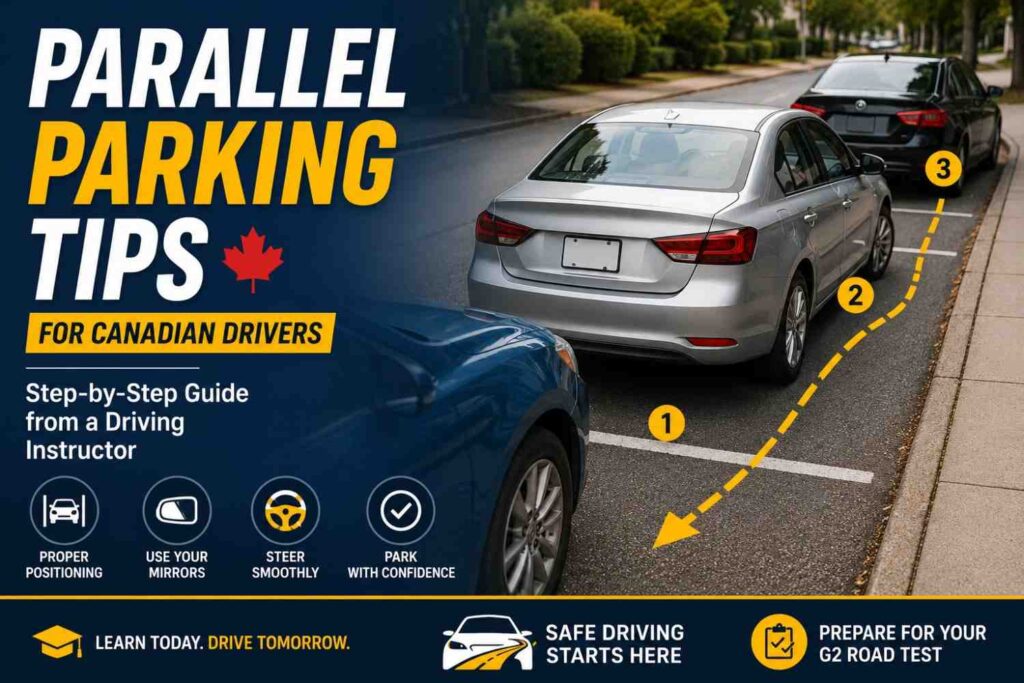
Parallel parking is one of those driving skills that makes many learners nervous at first, but it does not have to stay that way. In my years of teaching students across Ontario, I have seen countless drivers go from anxious and uncertain to calm and capable with the right method and enough practice. The truth is simple: parallel parking is not about luck. It is about understanding the steps, using reference points, and staying patient.
For many learners searching for driving school Milton, parallel parking becomes one of the most requested lesson topics because it is often part of the G2 road test. The same is true for students looking for driving school Mississauga, where tight parking spaces and busier streets can make this skill feel even more important. Once you learn the correct approach, though, parking becomes much less intimidating.
Why Parallel Parking Feels Difficult
Parallel parking feels difficult for most beginners because it requires coordination. You are steering, checking mirrors, watching traffic, judging distance, and moving slowly all at the same time. That can feel overwhelming at first, especially when other cars are waiting behind you.
The good news is that parking is a step-by-step skill. It does not require fast reflexes or special talent. What it requires is calm movement, good observation, and consistent practice. When students understand the process instead of trying to “guess” their way into the spot, they improve quickly.
Another reason people struggle is pressure. When there are cars behind you, it is easy to rush. But rushing usually causes mistakes. A slow and controlled approach almost always works better.
Start With the Right Mindset
Before you even begin the maneuver, remind yourself that parallel parking is a normal part of driving. Even experienced drivers sometimes need a second try. That does not mean you are doing anything wrong. It simply means you are learning a technical skill that improves with repetition.
As an instructor, I always tell students to breathe, slow down, and trust the process. Confidence comes from knowing what to do next. If you can stay calm, the rest becomes much easier.
Step 1: Choose the Right Space
A successful parallel park starts before the car even moves into position. You need enough space to fit your vehicle comfortably. If the gap is too small, it will be much harder to complete the maneuver smoothly.
When possible, choose a spot that gives you a little breathing room on both ends. New drivers often make the mistake of trying to force the car into a space that is not practical. That creates stress and reduces control. A slightly larger space is ideal when you are still practicing.
Step 2: Position Your Vehicle Properly
One of the most important parts of parallel parking is lining up beside the car in front of the space. Your vehicle should be parallel to that car, with enough room between the two vehicles to allow turning.
Good positioning gives you a much better starting point. If your car begins too far away or too close, the angle will be off and the rest of the maneuver becomes harder. This is why learning your reference points matters so much. The instructor should help you understand exactly where your car should be before you begin backing in.
Step 3: Reverse Slowly and Use Your Mirrors
Once you begin backing into the space, slow movement is essential. Many beginners turn the wheel too quickly or reverse too fast. That usually leads to overcorrection.
Use your mirrors often, but do not rely on them alone. Turn your head and check your surroundings carefully. You need to be aware of cyclists, pedestrians, passing cars, and any other hazards nearby. Safe parking is not just about fitting into the spot. It is about making sure the entire maneuver is safe from start to finish.
Step 4: Use Steering in a Controlled Way
Steering is often the part that confuses learners most. They know they need to turn the wheel, but they are not always sure when or how much. This is where practice and reference points are so valuable.
A common technique is to back in slowly while turning the wheel at the correct time, then straighten the wheel as the car enters the space. After that, you may need a final adjustment to bring the car closer to the curb and align it properly between the two vehicles.
Do not worry if the first few tries are not perfect. That is completely normal. Parking is a skill that improves with repetition. The more you practice, the more natural the steering becomes.
Step 5: Check Your Final Position
Once the car is in the space, take a moment to check your position. You want to be centered in the spot, straight, and at a safe distance from the curb. If you are too far out, too close, or angled incorrectly, you may need a small adjustment.
Final adjustments are normal. A good driver does not panic if the first placement is not perfect. They make a calm correction and finish the job properly. That is exactly the kind of control examiners want to see during a road test.
Common Mistakes Students Make
Over the years, I have noticed a few mistakes that happen again and again:
- Students rush because they feel pressure from other traffic.
- They turn the wheel too soon or too late.
- They forget to check mirrors and blind spots.
- They panic if the car is not perfectly aligned on the first try.
- They stop practicing once they make a small mistake.
These problems are fixable. In fact, most of them disappear after a few focused lessons. The key is to slow down and learn the process one part at a time.
Practice Tips That Really Help
If you want to improve faster, practice in a quiet area first. A calm environment helps you focus on steering, spacing, and timing without the added pressure of traffic. It is also helpful to practice with cones, markers, or even parked vehicles if available.
Another strong tip is to break the maneuver into stages. Do not try to think of the entire parking process all at once. Focus on one step, then the next. This makes the skill much easier to manage.
Finally, ask for feedback after each attempt. A good instructor can tell you exactly what to improve, whether it is your starting position, steering timing, or final alignment. That kind of feedback is often the fastest way to progress.
Why Parallel Parking Matters for Test Day
Parallel parking is more than just a test requirement. It is proof that you can control the vehicle carefully in tight spaces. Examiners want to see that you can stay calm, observe properly, and complete the maneuver safely.
Even if you do not park perfectly on the first attempt, what matters most is your awareness and control. A smooth, safe correction is much better than a rushed or unsafe movement. That is why practice is so important before your G2 test.
Final Thoughts
Parallel parking can seem stressful at first, but it becomes much easier when you approach it with patience and a clear method. The more you practice, the more confident you become. Start with the right position, reverse slowly, use your mirrors, steer with control, and make small adjustments as needed.
As a driving instructor, I always remind students that parking is not about perfection on the first try. It is about learning a repeatable process that keeps you safe and in control. With the right guidance and enough practice, parallel parking can go from being your biggest worry to just another skill you handle with confidence.
Leave a Reply